
A review of contract practices for risk managementon global ground engineering projects

ABSTRACT: Geotechnical risk and uncertainty in design are most often managed by instrumentation and monitoring (I&M). The aim of this is to confirm design assumptions (feedback) and to protect assets (assurance). If done well, this can be reflected in optimized designs, favourable insurance terms, as well as increased project confidence and faster progress. These require quality data to be delivered quickly, held in proper project context with a high level of transparency. Engineers need root level access to this data to best perform their roles. How should these monitoring and oversight roles and the accompanying software be contracted for the best outcome? Maxwell Geosystems have been engaged across the global supply chain for 20 years and have a unique window into the varied mechanisms of engagement. The paper reviews the approaches taken in various countries and by organisation type and comments on the pros and cons of the different approaches. Recommendations will be given for future engagement methodologies to achieve the goals of globally relevant tunnel and mining policy initiatives for risk management.
1. INTRODUCTION
Geotechnical risk is built into underground and ground engineering projects due to uncertainty in ground conditions, complex construction sequences, and the interaction between the works and surrounding infrastructure. Instrumentation and monitoring (I&M) has long been recognised as the primary mechanism by which this uncertainty is reduced during construction and operations. By observing actual ground and structural behaviour, monitoring enables designers and contractors to validate assumptions, modify designs and perhaps use Observational Method (OM) and implement pre-planned contingency measures before failure occurs. Despite the common recognition of the value of I&M as a risk management tool, its benefits are not fully realized—not by the absence of instruments, but by weaknesses in how monitoring data is procured, managed, controlled, and shared. Conventional I&M contracts typically focus on the supply of instruments and technology behind them rather than the delivery of timely, reliable, and contextualised information to support decision makers. From commercial points of view, there is no clear mechanism for sharing the data in a transparent manner between different subcontractors and project stakeholders. There is also an industry culture where teams work separately and in a somewhat protective manner over the data they produce and control who can access it. There also seems to be a lack of commercial interest or incentive to work collaboratively as a truly integrated project team. Therefore, data produced by each team is often locked within proprietary systems, stored in formats difficult for engineers to analyse effectively or delayed to the point where it loses operational value. This paper examines how monitoring and data management are currently procured on major global tunnelling projects, with a focus on contractual structures and risk allocation. Drawing on two decades of engagement by Maxwell Geosystems across owners, designers, contractors, and insurers, the paper identifies common failure modes, compares regional and organisational approaches, and proposes procurement models better aligned with current risk management objectives.
1.1 WHAT KIND OF DATA AND WHY IS IT IMPORTANT
Monitoring data in ground engineering projects typically includes geotechnical, geodetic, structural, and environmental measurements. Those measurements include effects of the construction works on the ground and asset behaviour, i.e. pore pressure, deformation, stress, vibration, convergence, settlement, etc., along with the causes that have produced the effects that are measured, i.e. load effects, rain, wind, temperature, etc. Increasingly, this data is supplemented by geological information (boreholes), topography, weather conditions, design predictions, as well as construction process data such as excavation progress, Tunnel Boring Machine parameters, operational parameters, incidents or events that may have an impact on ground movement. The importance of this data lies not in the measurements themselves, but in their interpretation within project context. Effective and reliable I&M data should:
- Confirm or challenge design assumptions (feedback monitoring).
- Provide early warning of unacceptable behaviour (assurance monitoring).
- Support decision-making during construction and operations.
- Provide an auditable record of performance for contractual, insurance, and regulatory purposes.
- Enable learning and optimisation for future projects.
To fulfil these functions, data must be accurate, timely, complete, traceable, and accessible to those responsible for design, construction, and risk governance. Engineers require root-level access to raw and processed data, metadata, assumptions, thresholds, and interpretation logic to enable professional judgement and informed decision-making.
1.2 REQUIREMENTS OF THE JOINT CODE OF PRACTICE
The Code of Practice for the Risk Management of Tunnel Works (ITA-AITES, IMIA, 2023) details a number of expectations for the delivery of tunnel works through each stage of design and construction. These expectations are focused on identifying, quantifying, tracking and updating risk in an active manner throughout the process. Section 6 describes the importance of information sharing in this and describes a unified live and risk-based digital model which is expected to inform members of the project on all data relating to tunnel risk.
2. THE PROBLEMS
Despite significant investment in instrumentation (around 1% of the project value), many projects fail to realise the full value of monitoring due to systemic data problems.
Failure to record the facts at the time: A key requirement of tunnelling is monitoring. Monitoring data is often collected, but the scope is variable, and it is often not reviewed in real time. Delayed processing, manual handling, or batch reporting can mean that critical events are only recognised after the opportunity for mitigation has passed. In extreme cases, data gaps coincide with incidents, leaving uncertainty about actual conditions when decisions were made.
Partial recording of data: Projects may focus on selected parameters while omitting metadata needed for interpretation. For example, deformation data without corresponding pore pressure or construction sequence information can be misleading. Partial datasets create false confidence or obscure developing risks.
Multiple versions of the facts: When data is stored in multiple software or copied between spreadsheets, reports, and isolated databases, multiple versions of the same measurement emerge. Discrepancies arise due to rounding, filtering, reprocessing, or simple transcription errors. This undermines trust in the data and leads to disputes over which version is authoritative.
Hidden data or data not shared: Contractual boundaries often restrict data access. Contractors may control monitoring systems, designers may receive only summary reports, and owners may lack direct access altogether. In some cases, data is deliberately withheld due to perceived commercial or contractual advantage, increasing systemic risk for the project as a whole.
Failure to agree the fact in a timely manner: Without a shared, transparent data environment, stakeholders may disagree on what the data shows, how it should be interpreted, or whether thresholds have been exceeded. These disputes consume time and erode confidence, particularly during critical construction phases when rapid agreement is essential.
Data unusable: Even where data exists, it may be unusable due to:
- Insufficient detail for future purposes, such as back-analysis or claims.
- Inconsistent formats across instruments, contracts, or project stages.
- Variable units and conventions that require manual reconciliation.
- Inaccessible or poorly accessible storage, including proprietary systems, local servers, or archived reports.
Missing the Retained Value of Data: Almost never is any investment put into retaining data in usable forms. Often it is archived and forgotten only to be resurrected by researchers looking for papers to publish. For businesses, this is their only permanent resource and should be curated and protected.
Inertia: During the course of their careers, engineers create their own processes. They are proud of these processes, and many produce excellent results. Creating these, and competing on these is, for many, an enjoyable part of the job. It is understandable that there is resistance to change and to conform.
2.1 EFFECTS OF PROBLEMS
The consequences of poor monitoring data management extend beyond technical inefficiency. They include:
- Increased likelihood of unanticipated ground behaviour and asset damage.
- Conservative design and construction decisions driven by uncertainty rather than evidence.
- Delays due to dispute, rework, or additional investigation.
- Higher insurance premiums or exclusions due to lack of demonstrable risk control.
- Weak factual basis for claims, disputes, or regulatory scrutiny.
- Loss of organisational learning and inability to benchmark performance across projects. Ultimately, these effects translate into increased cost, schedule risk, and reputational exposure for all parties involved.
Ultimately, these effects translate into increased cost, schedule risk, and reputational exposure for all parties involved.
2.2 WHY DO THESE PROBLEMS OCCUR
Contracting Arrangements: A key origin of problems results from the contracting structures adopted. Owners often find design and build contracts attractive and try and pass as much responsibility as possible to the contractor in the belief that this is shedding risk. Unfortunately, this mostly just sheds control. The ultimate political risk of non-delivery stays with the owner, but they now have little they can do about it. Keeping an element of control enables the owner to set the standard for how the works are delivered and particularly how data is managed.
Misaligned Motive: Similarly, a misalignment or non-alignment of motive does not produce the desired results for the owner. Sometimes parties to contracts desire opacity, not clarity of facts in the first instance until an advantageous interpretation can be identified. Sometimes a party will only provide data when too late for the other party to object.
Duplication: Man-marking, the tendency to have duplicate roles on either side of a contract, leads to duplicated roles and data with uncertainty over which data is the truth.
Lack of Upfront and Back-end Investment: Projects with budgets determined by competitive tendering are often reluctant to invest capital expenditure at the early stages of projects to set up systems and ultimately data is managed in a subjective ad hoc way.
Wrong Investment – Reinventing the Wheel: Engineers innovate and create. It’s what they do and what they enjoy. It’s no surprise therefore that there is a tendency amongst engineers to recreate what already exists in the marketplace. This is often harder than originally envisaged and rarely gets used again, leading to sunk costs which were avoidable with a little research.
Failure of Oversight: Even when specifications require systems to be implemented, supervising engineers are sometimes too busy on the construction to ensure that these systems are implemented effectively and in a timely manner early in a contract.
Inertia: During the course of their careers, engineers create their own processes. They are proud of these processes, and many produce excellent results. Creating these, and competing on these is, for many, an enjoyable part of the job. It is understandable that there is resistance to change and to conform.
Slow Setup: Systems implemented too late in a contract have to overturn established, albeit non-optimal processes. This is difficult.
Siloed Behaviours: Data which is “owned” by certain individuals leads to siloed behaviour and bottlenecks, which increases project risk and is a barrier to progress.
Lack of Investment in Training: Projects often focus on paying for the software installation but neglect the training to make the best use of it once in.
No dedicated data role: Aside from the change from draftsman to BIM operator, few site organisations plan for a dedicated data role
3. CONVENTIONAL CONTRACTING APPROACHES
Traditionally, monitoring has been procured as a subcontracted service or as part of the construction scope, with emphasis placed on the supply, installation, and maintenance of instruments, and on periodic reporting. This may apply to design bid build and design build contract forms.
In such conventional arrangements, the contractor often controls the monitoring system, appoints the instrumentation subcontractor, and manages the flow of data through reports. Data ownership, access rights, and long-term stewardship are frequently poorly defined. Designers and owners may receive only interpreted summaries rather than direct access to raw data and metadata. Software platforms are often selected for convenience or lowest per item cost, resulting in multiple systems, fragmented datasets, inconsistent formats, limited transparency and higher overall cost.
Motivation for monitoring is varied but is most often used primarily for compliance, assurance, or asset protection rather than for adaptive decision-making.
These approaches persist due to historical practice, procurement norms that treat monitoring as a trade activity, and contractual structures that discourage change once construction has commenced. However, they are increasingly misaligned with the requirements of modern risk management, particularly where design feedback and, more formally, the Observational Method (OM) is intended to be applied.
3.1 Build Only – MWH/MM – Resident Engineer’s TDMS System (Hong Kong HATS Phase 1 1998 2001)
In 1997 the Hong Kong Harbour Areas Transfer Scheme Stage 1 contracts were re-entered due to a dispute about impossibility. These 26km of deep tunnels beneath Hong Kong Harbour had encountered faults and water inflow which the contractor was finding difficult to control through grouting. The contracts were let as a traditional Build Only and were supervised by resident Engineering staff (RSS). As a result of the re-entry into the contract attention focused on the need for transparent fully audited, and consistent records. A tunnel database management system (TDMS) was developed by the RSS to connect separated teams using dial-up modems to synchronise data overnight and centralised software processes to audit the data to ensure quality, completeness and consistency. The data covered time records, critical production records such as tunnel boring machine (TBM) performance, drilling and grouting, rock mapping and support installation, thousands of record photos as well as borehole investigations and instrumentation readings.
The benefits of the system were profound. The replacement contracts were subject to intense scrutiny by lawyers from both parties, so a high degree of transparency was essential. This was particularly true when closing commercial claims. The agreement of facts early meant that attention could be placed on arguing interpretation and once agreed the ultimate quantum of claims was settled inside six months which was highly unusual for a contract of this type.
The arbitration in 2001 was also settled relatively quickly in favour of the owner and the records provided by the owner’s team were the dominant data resource employed. In addition, since this was only the first phase of a multi-phase project, the data resources were used to plan phase 2 with provisional quantities ultimately coming in within 5% of estimates.
3.2 DESIGN AND CONSTRUCT – LA METRO 2018-2023
In LA Metro Purple Line contract, the specification called for a monitoring information management system (MIMS) with the added requirement to host and display TBM data. The MIMS was requested from the instrumentation and monitoring subcontractor whose remit was to install and take readings and present the data. The system supplier in this case was isolated from the actual end user the Contractor, the Engineer and the Client and as a result the use of the system was mainly as a compliance and assurance tool and not as a means of risk reduction or design feedback. This is the most common application of such MIMS systems, which misses significant opportunities.
3.2 DESIGN AND CONSTRUCT – LA METRO 2018-2023
In LA Metro Purple Line contract, the specification called for a monitoring information management system (MIMS) with the added requirement to host and display TBM data. The MIMS was requested from the instrumentation and monitoring subcontractor whose remit was to install and take readings and present the data. The system supplier in this case was isolated from the actual end user the Contractor, the Engineer and the Client and as a result the use of the system was mainly as a compliance and assurance tool and not as a means of risk reduction or design feedback. This is the most common application of such MIMS systems which misses significant opportunities.
3.3 DESIGN AND CONSTRUCT WITH ALTERNATIVES – LIANTANG TUNNELS HONG KONG 2014 2018
Where contractors put forward alternative designs, monitoring then becomes an essential component for the contractor to prove the sufficiency of the design and its performance to the supervising engineer.
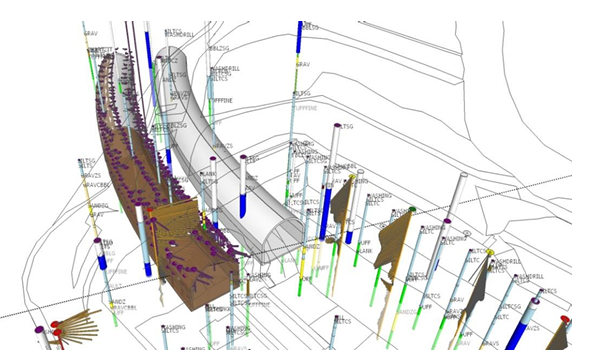
On the Liantang Tunnel project, a design and construction road tunnel through a mountain in the north of Hong Kong, the job was won by Dragages based on a design and construct contract. The design modified the reference design by implementing the faster TBM tunnelling earlier in the programme. Portal excavation was progressed as far as possible while the TBM was procured, and as soon as available, the TBM would be launched, with widening undertaken later through the removal of sacrificial segments and re-excavation using a purpose-built gantry. One problem lay in uncertainty in the nature of the decomposed ground, with the tender design calling for invert struts to resist base heave and closure. Removing the requirement for these struts would liberate 42 days in the critical path programme. An observational engineering alternative was proposed by the contractor (Storry et al, 2017) using carefully designed instrumentation of the initial adit arch to determine the ground behaviour during excavation. If no closure moments were observed, it was safe to omit the base inverts. Ultimately all the invert steel was removed, resulting in a win for the entire project, not just for the Contractor. Using observational engineering in this way, coupled with alignment of motives also decreases risk since design is constantly being assessed against performance.
In this contract, the data systems were specified by the owner and implemented by the Contractor. Whilst in these scenarios the motive for running the systems was largely compliance with the specification, the transparency the systems provided undoubtedly helped in the agreement to use the observational approach to progress the alternative.
4. WHO STANDS TO GAIN BY FIXING DATA PROBLEMS
Improving how monitoring and data management are procured and governed creates value across the whole project environment.
Owner: Owners benefit from reduced whole-life risk, improved asset protection, and greater confidence in decision-making. Transparent, high-quality data supports administration, assurance, and accountability to regulators, financiers, and the public.
Investor: Investors gain from reduced uncertainty, more predictable outcomes, and stronger evidence of risk management. Reliable monitoring data can support favourable financing terms and reduce contingencies.
Insurer: Insurers rely on credible monitoring to assess exposure and to validate that agreed risk controls are in place. High-quality, accessible data can lead to improved terms and reduced premiums.
Designer: Designers benefit from feedback on assumptions and performance, enabling optimisation during construction and the application of the Observational Method (OM). This can generate significant value for the project—not only through cost savings and improved safety, but also by completing works faster, thereby minimizing disruption to the public.
Contractor: Contractors gain from early warning of hazardous conditions, objective evidence of performance, and reduced dispute risk. Clear, shared data environments can also support collaborative problem-solving rather than disagreements.
Lawyer: While disputes may never be eliminated, lawyers benefit from a clear, auditable factual record. Well-managed data reduces ambiguity, shortens disputes, and increases the likelihood of resolution based on evidence rather than interpretation.
5. ALTERNATIVE CONTRACTING APPROACHES
Alternative contracting approaches have been sought to address the various difficulties around project delivery. These now include Early Contractor Involvement (Progressive Design in the USA), Target Cost Contracting, Alliancing and Public Private Partnership. In the area of data management, owners and their insurers have also started to investigate ways to use data to minimise risk and to establish more control over the works and better, more reliable forecasting. Examples of these are given below:
5.1 INDEPENDENT MONITORING CONSULTANT (MASS TRANSIT RAILWAY CORPORATION 2010 TO 2025, WIL, SIL, XRL, SCL, TUNG CHUNG EXTENSION)
The merger of the Mass Transit Railway Corporation (MTRC) and the Kowloon and Canton Railway Corporation (MCRC) in 2007 raised issues of monopoly on future railway developments in Hong Kong. One way around this was for the government to appoint independent consultants to provide oversight. One such role, the Independent Monitoring Consultant or IMC, focused on project assurance and provided an independent system for all monitoring data on the project and physically checked 15% of the data collected by contractors. This central trust but verify” role was applied on the Regional Express Line, Kwun Tong Extension, South Island Line, Shatin Central Link and currently on the Tung Chung Extension.
The central resource and effective management and audit of events arising undoubtedly increased the quality, timeliness and effectiveness of the data. The lowering of risk was reflected in the projects ability to negotiate lower insurance costs.
5.2 INFORMATION PARTNERING SINGAPORE POWER (NS-EW CABLE TUNNELS AND JIPCT 2011-2015)
On phase 2 of Singapore Power’s programme of deep tunnels for power transmission, the executive decides to increase transparency in data across the project to improve in experiences in Phase 1. To do this late in the tendering process, the client introduced the concept of information partnering, adopting standard partnering principles. For the 50km of Phase 2 tunnels, six contractors and the client agreed to share the cost of a single centralised resource for data for the project and run this through a steering committee and project managed by the delivery consultants. A partnering charter was drawn up with key goals to which the company executives formally signed up:
- A single source of truth
- Increased transparency
- Quality data quickly
- Minimise manual data processing
- Minimise meeting preparation time
- Shorten meetings by agreeing data and arguing interpretation
With these principles, the project was able to successfully complete the works on time and on budget with relatively small project teams and without the need for man-marking. With everything in one place and risk managed proactively, unexpected ground movements were minimised and did not affect the programme.
5.3 OWNERS SYSTEM (DTSS2 STEMS SYSTEM, CHANGI AIRPORT TUNNELS AND MEGASPINE 2016-2025)
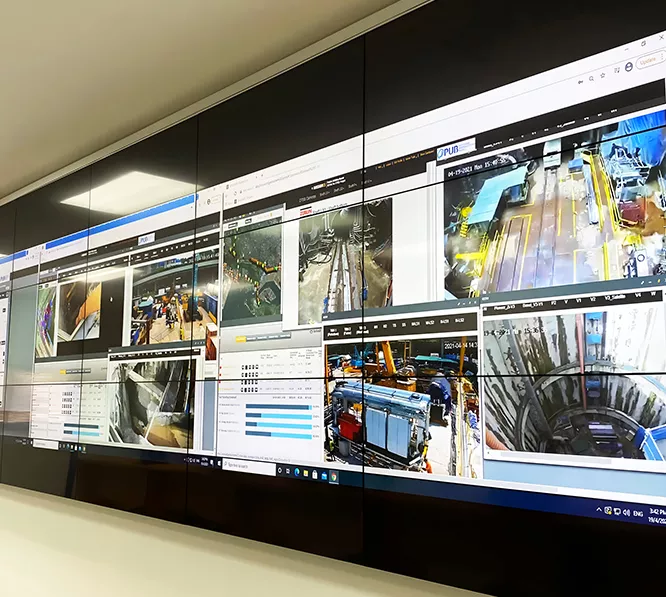
With more time to plan, owners can now take complete control of data. Systems are now available, proven on very large projects and can be implemented quickly and with minimum risk. The DTSS2 project in Singapore followed on from the power project and comprised 100km of machine-driven deep tunnels and pipe jacks between 35 and 50m below ground. The Shaft and Tunnel Excavation Monitoring System (STEMS) (Woo et al. 2021) was implemented as the single central resource for all data and was engaged directly by the Public Utilities Board and project managed by their delivery consultant. At the same time the system was also implemented by the Changi Airport Group to deliver their very sensitive cross-airport megaspine and baggage handling tunnels. The system extended the success of the earlier systems with continued highly successful tunnelling delivered on time and budget with settlement well within requirements. This enhanced level of oversight was particularly appreciated due to the events of the Covid pandemic causing a shutdown of the engineers and contractors offices and the move to online working from home. The system became the virtual construction site for more than 1200 staff members and provided a very high level of business resilience during this difficult time.
5.4 VALUE ENGINEERING: MONITORING, DATA MANAGEMENT, AND THE OBSERVATIONAL METHOD
The requirements outlined in the JCoP (see 1.2) ask tunnelling projects to accept that all ground engineering projects have uncertainty particularly in the ground parameters and behaviour. Within this in mind methods can be adopted to use data gathered during the project to confirm design assumptions or, if different, to guide how the project should proceed. This has been formalised in the Observation Method.
The Observational Method (OM) provides a structured framework for managing geotechnical uncertainty by explicitly linking design, construction, and monitoring through a feedback loop. Rather than relying solely on often conservative assumptions made during design, the OM allows designs and construction methods to be refined in response to observed ground and structural behaviour, provided that pre-defined procedures, trigger levels, and contingency measures are in place.
Field measurements are therefore central to the effective application of the OM. High-quality, reliable, and timely data enables engineers to verify design assumptions, calibrate analytical or numerical models, and make informed decisions during construction. As demonstrated on major infrastructure projects such as HS2, the use of quality instrumentation data has enabled meaningful design optimisation during construction, resulting in programme acceleration, cost savings, and improved safety.
However, the OM places strict demands on monitoring and data management. Data must be delivered in near real time, accompanied by sufficient contextual information (construction sequence, groundwater conditions, loads, and boundary conditions), and made accessible to all relevant stakeholders. Poor data quality, delays, or restricted access undermine confidence and can prevent the OM from being applied, even where it was originally envisaged. This is where systems are essential to automate this process and must be implemented with the full context of ground characteristics, prediction, progress, activity and monitoring.
6. CONCLUSIONS
The success of projects has been shown to be intimately linked to the flow of information. Projects with high degrees or transparent, audit and oversight leading to quality data quickly make the best of engineers and lead to positive outcomes. The choice of contract arrangements, investment in systems and training with a significant element of control by the owner benefit all parties and lead to a lowering of risk.
References
LAI LYNN WOO, AUNG KO KO SOE, KYI KHIN, DARRYL TAN, ANGUS MAXWELL and ELPIDIO VALDEZ. JR (2021) Implementation of Shaft and Tunnel Excavation Monitoring System in the Deep Tunnel Sewerage System Phase 2 Project. Proceedings of Underground Singapore
R. B. STORRY, X. MONIN and V. POON (2017) Large span mined tunnels in soft ground: support design, instrumentation and observational approach. Proceedings of the World Tunnel Congress 2017 – Surface challenges – Underground solutions. Bergen, Norway.
INTERNATIONAL TUNNELLING AND UNDERGROUND SPACE ASSOCIATION (ITA-AITES) AND INTERNATIONAL ASSOCIATION OF ENGINEERING INSURERS (IMIA) 3rd Edition (2023) A Code of Practice for the Risk Management of Tunnel Works 3rd Edition.
Dr Angus Maxwell
Maxwell Geosystems UK Ltd, London, United Kingdom
Dorota Symonidou
Maxwell Geosystems Europe S.R.L, Krakow, Poland
Disclaimer: For reference only. Copyright remains with the original owner: Underground Construction Prague 2026
Follow our socials!